Features for Lineout magazine
I was commissioned to write a couple of features for September’s World Cup edition of Lineout – the Indo’s quarterly magazine where rugby meets fashion. I concentrated more on the rugby side. . .
Unfortunately, Lineout is a law unto itself, and the content did not go online, but here’s my copy – this piece is about former players making the transition to punditry, in the context of TV3’s World Cup coverage
Not here to make friends:
Players moving into punditry risk upsetting former team-mates if they are too critical, but TV3’s World Cup panel tell Sam Wheeler that they will be telling it like it is – because blandness won’t wash with the Irish public
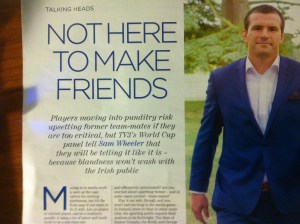 Moving in to media work is seen as the easy option for retiring sportsmen, but it’s far from easy if you want to do it well. Any ex-player, or current player, can be a mediocre pundit; it takes a lot of talent and hard work to be a top-class one.
An illustrious playing career does not in itself prepare you for TV analysis; possessing immense physical strength, an inordinately high pain threshold and technical mastery at the scrum are useful attributes on the rugby field, but they hardly guarantee articulacy and insight in the studio.
There are endless examples of sporting legends failing dismally to make the transition to TV – and bad punditry can sully the memory of a fine playing career every bit as much as an unsuccessful switch to management.
Players are often trying to learn new skills that can take professional broadcasters years to master, and it can be a daunting challenge.
Iconic former Ireland and Lions hooker Keith Wood, recruited by TV3 for their World Cup coverage, remembers his early foray into TV – he was in his early 20s when, while recovering from injury, he was pitched in to host a series of BBC’s old Rugby Special programme.
“It was tough, scary, brilliant,” he recalls. “It’s outside the comfort zone. There’s a huge adjustment to make. A transition.”
Even for the players who are naturally eloquent and comfortable in front of the cameras, punditry can be a minefield. Where do you aim for on the spectrum between pointlessly bland and offensively opinionated? Are you worried about upsetting former – and in some cases current – team-mates?
Play it too safe, though, and you won’t last too long in the media game. In Ireland, more so than in other countries, the sporting public expects their analysts to be forthright. The likes of Eamon Dunphy, Joe Brolly and George Hook often generate more headlines than the action they are analysing.
TV3 have certainly made it clear that they want more than platitudes from their pundits, although they don’t want to go too far.
“Our mantra as a station is ‘we entertain’,” says the station’s Group Head of Sport Kieran Holden, whose pundits for the tournament include former Ireland foursome Wood, Hugo MacNeill, Shane Jennings and Peter Stringer, as well as ex-Leinster coach Matt Williams and former England out-half Stuart Barnes.
“We’ve told our analysts, ‘don’t be afraid to call it how you see it – you’re not here to make friends’. Give praise when praise is due, but you have to call it like it is. Just saying ‘oh, he’ll be disappointed with that’ won’t wash with the Irish public. People expect a lot more.
“But we don’t want to be a pantomime either. We’re not there to grab headlines – we’re there to entertain, educate and inform.”
Anchor Matt Cooper adds: “We’ll be truthful. People expect things to be real – we won’t be causing controversy for the sake of causing controversy, but we won’t be toning things down, saying ‘you can’t say that’. But we won’t be having people say things for the sake of making a headline.”
Wood has been doing TV work for over two decades, and he reckons he has managed to avoid upsetting people.
“I’ve had very few big issues with that,” he says. “You have to be critical, but you shouldn’t personalise it – you fall into that trap every now and then but it shouldn’t be character assassination stuff.
“Players are unbelievably hard on themselves: there’s a point in their career where they realise it doesn’t matter what other people say, they’re going to even harder on themselves than what the person said. I’ve had very little grief back – a couple of little bits, but not bad.
“I’m there to give critical analysis, but critical analysis isn’t to be full of criticism. It’s to give your determination of what’s going on, good, bad and indifferent.”
For Stringer, as a current player – the 37-year-old has just joined Sale Sharks – the hardest part of TV work will be to criticise a team that he still wants to be part of. He could come across as bitter if he says anything negative about any of the Ireland scrum-halves, yet scrum-half play is the area where he can offer most insight, and he is not willing to abdicate his responsibilities by sitting on the fence.
“That will be a challenge,” he accepts. “It’s different when you’re still playing, and I feel I could be out there doing a job for Ireland. I still want that No 9 jersey, so it will be hard to judge those guys.
“But I’ve got a job to do. I will be honest in my approach, straight up. If the Ireland scrum-half has a good game, I’ll give credit where credit is due. And if he has a poor game, I’ll point that out.”
Wood concedes that the games he found hardest to analyse were those involving his then-Ireland team-mates – and he recalls particularly dreading having to comment on the performance of Shane Byrne, the man who was standing in for him in the middle of the Ireland front-row during his injury-enforced absence.
“I was really worried about that before that first game, but Shane played really well. And I was thrilled. I really, really was. I didn’t want to have to be critical of him. And he was man of the match. I thought that could have been a pinch point for me – I don’t want to be that guy to slag off my successor, and I didn’t have to, thankfully. He had a cracking season, and it was perfect.
“In retrospect, I was far more comfortable picking holes in other teams. Because with Ireland there were personal relationships, you had fought in the trenches with these players.”
Only a couple of months into retirement, Jennings has ‘fought in the trenches’ with a large proportion of the Ireland World Cup squad, at provincial and international level. He is confident he can do his job without wrecking friendships – having played for three years under Joe Schmidt at Leinster, he can bring an insight into what the Ireland coach is thinking.
“I don’t think I’ll be criticising anyone, whether I played with them or against them. For me, the fortunate thing is that having an understanding of the game-plan, and an idea of the players they are, I’ll have a pretty good knowledge of what they can do, and I’ll be focusing on the positives, the more optimistic side of it, rather than being the fella who’s giving out the whole time.
“I don’t see that as my way of doing things. I certainly won’t be a hatchet man. I try to be as honest as possible, and if you’re honest, people can’t have too much of a gripe.”
TV3 are aware that a lot of viewers will be relatively new to rugby; the analysis needs to cater to this audience without patronising more hard-core rugby fans.
“There’s a balance,” says Jennings. “Rugby can be quite complex. You have to explain what’s going on to everybody, so they get a good feeling and they can get behind the team without feeling ‘I don’t understand this’.”
Sometimes, technological innovations can bring extra clarity and depth to the analysis; but overuse of these swanky graphic tools can also muddy the water and irritate the viewer.
“We’ll make sure our coverage looks good,” says Holden. “We’re going out in HD and we’ve invested in a big studio. We’ll have software installed to help the analysts highlight things on the field. But we’re not trying to reinvent the wheel with our coverage. It’s about using our analysts’ expertise.”
Wood adds: “I think you can get caught up in some of the new technology as opposed to the images themselves. Let’s not overplay our card: the entertainment of a rugby match is the rugby match. What we need to be able to do is highlight that – the nuance of the game, the little spark. Technology can be used for that. But you don’t want the technology to become everything.”
So the panel won’t be spending weeks in computer rooms trying to master a bewildering array of analytical tools. But it’s not a case of just turning up and spouting away. Analysts need to have vast amounts of knowledge at their fingertips, about all the competing nations.
“You need to do a huge amount of preparation,” explains Wood. “People often say, ‘sure you know rugby, you played it all your life, you know the players’ – that’s one of the biggest pitfalls you can fall into. You have to watch a lot of rugby, and read a lot. I like to challenge my assumptions all the time.
“As soon as we start going to full preparation, in the first week of September, it’s like boot camp. You need to know the guys on all the teams, you need to know what makes them tick.”
Jennings likens the build-up to preparation for a big match in his playing days, saying: “If you go into a game underprepared, that’s when your nerves get a bit edgy; doing work with TV3, we’ll all be prepared, so there’s no need to be nervous Once you’ve prepared, you’re able to talk; if you’re not prepared, you won’t be able to talk.”
Ghost stories – back in the writing game
I decided to get back into writing, initially by ghosting a weekly column for Leinster star Isa Nacewa in the Irish Independent.
Here are a couple:
isa-nacewa-joe-was-totally-different-when-he-came-to-leinster
isa-nacewa-schmidts-insight-into-french-psyche-can-tip-the-balance-irelands-way
Opinion pieces – the nationality question
Every now and then, I stood in as the Yorkshire Post’s hard-hitting answer to Hugh McIlvanney or Vincent Hogan and was given free run of the back page to vent my opinions. Here are a few examples:
The topic of blurred nationality is still highly relevant in sport, even if the subject here, Lesley Vainikolo is currently residing in the ‘where are they now’ file – at the time, he was pulling up trees for Gloucester (5 tries on Premiership debut, albeit against Leeds) in his first season since switching from rugby league, where he was a force of nature. (It seems to end rather abruptly – I blame the subs)
Heineken Cup timeline – how Irish sides took over
Heineken.ie commissioned me to write a timeline of the Irish provinces’ exploits in the Heineken Cup. From small steps in the early days, to an era of dominance…
Archive: England 2, Croatia 3 – Wally with the Brolly
A bizarre set of circumstances meant I ended up reporting on one of the iconic England football matches. Hilarity ensued, thanks to Scott Carson’s howler for the ages and Steve McClaren’s Wally with the Brolly moment (which wasn’t really appreciated till the next morning):
Archive: England rugby – the glory years (er, for Ireland)
I covered England for eight years, either side of the 2003 World Cup success: from their peak to some pretty barren times.
Jonny gets the boot after Murrayfield 2008, possibly the most dismal match I ever watched (and I covered Leeds Tykes for 7 years):
Archive: Arts and travel (Morrissey, Morocco and John Shuttleworth)
Occasionally I have managed to escape my sports ghetto. I coerced the features department into letting me pen what amount to hagiographies of two of my heroes, Morrissey and John Shuttleworth. And I went on a press trip to Morocco.
The-eternal-appeal-of-this-Charming-Man
Read the rest of this entry
Archive: Dispatches from Rugby World Cup final 2007
Tightly controlled Yorkshire Post purse-strings prevented me from covering the whole tournament, but I managed to badger them into letting me go to the final, once England ground their way through the knockout stages.
I pretty much had to hitch-hike there – I think I wrote most of this stuff on a bench in Lille station, unable to get a direct Eurostar home. Still, it was quite an occasion. These two bits are part of a supplement I produced for the final.
Archive: Freelance pieces for top UK titles
During my time at the Yorkshire Post, I was regularly commissioned to write match reports for various national papers. I had to use noms de plume, though. Here’s a small selection:
Historic occasion – I was at Headingley on the day Mark Ramprakash became almost certainly the last man to reach a century of first-class centuries and wrote it up for the Sunday Times (pity it’s behind a pay-wall):
Archive: Wheeler-hosted webchats (Yorkshire Post)
Here’s me answering questions from readers online, ‘live’. Even the questions that came in before my hour-long slot were kept hidden from me – honest!
 Sam Wheeler - the showreel